Rolling up ravaged ruins on the spur of the moment
This post is part of the RPG Blog Carnival: Underworld & Wilderness Adventures.
I have been running an open-world sandbox for five years now. It is set in the Wilderlands of High Fantasy, which I fell in love with due to its minimal keying and maximum flexibility. The former allows me to prepare efficiently, while the latter enables me to place whatever I want into the setting without worrying too much if it will break something.
Placing published modules is relatively easy. Read up, place it in a hex, re-name the site and key characters, and change the flavour as needed. But where Wilderlands always shined are the adventuring locations, described in the briefest of lines.
One of the defining characteristics of a sandbox is that players are free to roam as they wish. This freedom does not mean freedom from consequences though. I continuously roll for wilderness encounters. These can be with wandering monsters, but can also mean encountering a ravaged ruin or a lurid lair.
I have a Judge binder with a collection of one-page dungeons, geomorphs, and random tables. This allows me to quickly generate either of the aforementioned. The smaller sites can be rolled very quickly. The larger sites are best rolled iteratively. For example, if it is a dungeon complex, first time the players encounter it they will most probably explored the environs, interact with the entrance, and maybe the first few rooms. Thus, there is no need to roll hundred keys in advance.
But let's go back to smaller sites. These can be captured in a few short paragraphs, and sometime don't even need a map. Allow me to demonstrate with a real example. I will go step by step, and explain my thinking as we go along.
Preparation
Since I am running an OD&D game, I decided to limit myself to period appropriate resources. Thus, I used:
Tome of Adventure Design was an exception, which I will explain later.
I put the Judge binder and the books on the table, opened a plain text editor on my laptop, as well as a digital dice roller (I roll in terminal).
Rolling a ravaged ruin
When rolling smaller sites I consider them to be either a ravaged ruin or a lurid lair. There are tables for both in Ready Ref Sheets. In this case I roll on tables on pages 43 and 44:
| Element | Roll | Result |
|---|---|---|
| Class | 4 | Vestiges |
| Condition | 8 | Large crater |
| Covering | 10 | Vines |
| State | 5 | Corroded & eroded |
| Keeper | 4 | Undead-types |
| Vestiges | 3 | Fountain |
| Fountain | 6 | Spray |
I have a fountain of spraying type. It is corroded and covered with vines. The fountain is in a large crater, and it is guarded by an “undead-type.”
At this moment I turn to Eldritch Wizardry because it has the most comprehensive encounter tables for OD&D. I turn to page 56 and roll on the UNDEAD-TYPES column. Will O’ Wisp is the result. Now I turn to page 35 of Greyhawk to read more about the monster:
WILL O’ WISPS: These creatures are highly clever and seek to lure their intended victims into some spot where they will be trapped and expire, and when their life force leaves them the Will O’ Wisps feed upon this force. They commonly inhabit deserted places which have areas of quicksand, mires and the like. Any metal weapon will harm a Will O’ Wisp—providing it can hit the creature. If cornered the Will O’ Wisp will strike at its opponents doing 2–12 points of electrical damage per hit. These creatures can alter shape, become bright or dim, or disappear entirely at will. In order to save their lives they will reveal where their treasure is hidden, but the Will O’ Wisp has to be at 3 or fewer hit points to so reveal its treasure.
What a perfect combination!
Will O’ Wisp has treasure type A. I reference Monsters & Treasure, and roll:
- 4 000 gold pieces
- 21 gems (12 000 gpv: 4×50 gpv, 8×100 gpv, 4×500 gpv, 4×1 000 gpv, 1×5 000 gpv)
16 000 gp worth of treasure with a very lethal defender.
At this moment I decided to look up fountains in the Tome of Adventure Design. Of course there are. I decide to roll on Table 3-53A and 3-85:
- The Fountain of Good and Bad Fortune
- How it functions: Stand in precise locations
- What happens when functioning: Component slides up
- What is accessed: Delivers a key
Great, just the right amount of information. Now I have everything I need to make sense of it.
Interpreting the results
First, the crater size. By large I will go with sub-hex size, which in my case is 1 league (2,5 miles or 4 kilometres). Craters of these size usually disappear after some time, so since this one still exists it is not older than 100 000 years.
Due to its size it might not even be clear to adventurers they are entering a crater. When they reach any of the adjoining hexes I will mention that the ground slopes downward, concavely. If there is a dwarf, elf, druid or ranger I would mention that the entire area is depressed.
Whatever made the crater is not what led to ruin of the fountain and surroundings. There are vines, meaning there is overgrowth. Thick shrubs, brambles, and bushes carpet the entire crater. During the day, the fountain is in essence invisible. During the night, Will O’ Wisp shines from top of the fountain, visible from all adjoining hexes.
Once the crater is entered visibility is significantly reduced, because it is 30 feet deep, and completely overgrown. Speed is reduced to half. One needs a machete or hatchet or similar, otherwise they have 1:6 chance to waste a time (a turn or an hour) finding their way forward.
Will O’ Wisps lures greedy people to the fountain during the night, but dims during the day. When someone gets close to the actual fountain, Will O’ Wisp relocates and shines there when the night comes. Its treasure is not in the fountain, but in one of the gnarly, bent trees, elsewhere.
The fountain itself is 30 feet wide, and 20 feet tall. It is made of brass, and covered in verdigris (green patina), making it near impossible to find given the vines. It is filled with soil and does not flow anymore. I imagine a typical fountain with some sort of animals that were supposed to spout water as a central feature. These then are ten feet tall, with a centre-piece flower on a stalk adding another ten feet. There are four animals, cranes, each facing a cardinal direction. Spouts are the bottom of their raised foot (right).
If a person stands in front of each, with their right foot raised, then the flower on top falls off. Within the stalk is a rolled thin sheet of bronze with pattern. If one folds along the pattern, they get a key.
“The Fountain of Good and Bad Fortune” is how the locals calls it. I am going to use this to create rumours. People call it “good fortune” because it fulfils wishes. They call it “bad fortune” because those go looking for it either don't return, or return having given up after following the light.
Now that I have thought this through all I have to do is draw the map and write it up so I can pull them when needed.
Drawing the map
Regarding the map. One league is 2,5 miles, which is 4 400 yards. OD&D movement rates are 3/6/9/12, which would be 30/60/90/120 yards in the wilderness. There are two moves per turn, so 60/120/180/240 yards. But due to terrain everyone is moving at half speed (except Druids).
Since we play online using Owlbear Rodeo I can quickly draw whatever. Given the aforementioned, each square will be 120 yards, with a 40 by 40 square map (4 800 yards top to bottom, left to right).
There will be eight points on the map: one fountain, six locations where Will O’ Wisp moves if someone comes close to the fountain, and treasure location.
So, I open Owlbear Rodeo, and quickly draw the following:
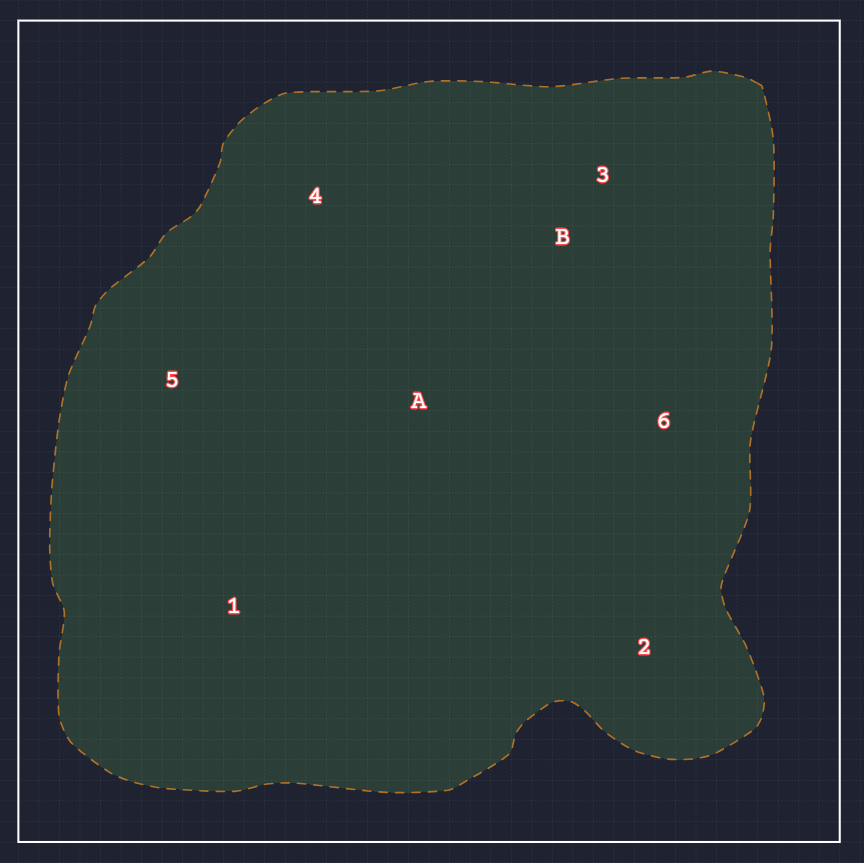
A. Fountain. B. Gnarly tree. 1-6. Alternative beacon locations.
Writing the hex key
The Divine Beacon of Fortune. A thirty foot deep crater roughly 3 800 yards long and 3 400 yards wide is brimming with bushes, brambles, vines, and bent, knotted trees. The overgrowth conceals its true depth. Within the crater it is difficult to see more then several hundred yards ahead. It is also difficult to move (half speed) and advance without machete, hatchet, or similar tool (1:6 chance to waste a turn find path forward). For every hour spent traversing the crater, there is 1:6 chance for encountering a dessicated humanoid corpse.
At night, a bright light is visible from three miles away. This, the locals say, is the Divine Beacon of Fortune. Those who reach its source are destined to have their deepest wishes fulfilled. The source of light is Will O’ Wisp, and the crater is its hunting ground. It most often shines above the Crane Fountain (A), because it is roughly in the centre of the crater.
If anyone comes close, it will relocate to another location and shine there (roll 1d6 to determine the spot). It will shine only during the night, savouring in the suffering of those unwilling to give up their treasure hunt. It will only electrocute those that attempt to harm it. A gnarly, bent tree in north-eastern portion of the crater (B) hides its treasure: 4 000 gold pieces, and 21 gems (12 000 gpv: 4×50 gpv, 8×100 gpv, 4×500 gpv, 4×1 000 gpv, 1×5 000 gpv).
The Crane Fountain is a large brass fountain, with thirty feet wide round base, four teen feet tall cranes facing cardinal directions, and and a twenty feet tall flower in the centre. It is completely covered in verdigris and vines, making it near impossible to find (three consecutive passive secret doors checks, or two active consecutive secret door checks).
The fountain is filled with soil, rotting vegetation, and bones of those that had perished long ago. The spouts are at the bottom of cranes' right legs, which are raised. If four people stand in front of each, with their right leg raised, then the flower will fall off. Atop the rod (flower stalk) is a circular depression, and within it is a thin, rolled sheet of bronze. On it is some sort of linear pattern. If the sheet is folded according to the pattern, it forms a key.
OD&D stat block Will O’ Wisp (1): HD 9, AC -8, MV 18, ATK special, DMG 2-12, Source GH35
Swords & Wizardry stat block Will-o’-the-wisp (1): HD 9; AC –8[27]; Atk shock (2d6); Move 18; Save 6; Morale 12; AL C; CL/XP 11/2400; Special: lights (brighten or dim, or form wraith-like form).
Finishing and filing
I stop the timer. It says 19 minutes and 27 seconds. Not bad. I lost some time thumbing through the book, and then looking up median crater sizes. But otherwise, I am quite happy. A gameable site; dynamic so I can use it next time the players encounter a ravaged ruin in most of the hexes. I can also use it as a source of rumours if I want. I left enough details for myself to just run it from the key and image, even if I use it in two to three years. Not to mention that it was fun to do.
But back to my main point. I hope this demonstration was helpful in seeing how well curated set of random tables and a little bit of association and imagination can quickly produce a gameable site for a sandbox game. The beauty of such open-ended campaigns is that you never know what might happen next. That foldable brass key? Maybe it opens a portal to another dimension. Or a lich's crypt. Or king's vault. Who knows? All I know is that I have a site I can use, knowing that we will have good time.
These small sites are not the main course, but they are an important part of the sandbox experience because they make the world lived in, instead of disjointed points of light and dungeon complexes. Plus, in a long running campaign it is good to have smaller sites that can be tackled in a session or two. This is especially important when players have multiple characters engaged in different activities. But that might be a topic for another blog post.
#RPGBlogCarnival #OSR #Resource
Subscribe to get the latest post in your inbox. No spam.
rootring
Prev · Random · Directory · Next