Resource: On The Long-Term Campaign Play Q&A
The Long-Term Campaign episode went live a month and half ago on The Classic Adventure Gaming Podcast. Gus invited us to share more about our Conquering the Barbarian Altanis campaign. This Monday we celebrated our 200th session.
Since the episode went live I have received a number of questions via Discord, email, and in-person. I have collected them all (as much as I could remember) below. Feel free to comment if you have additional questions. You can listen to the episode here and find my summary here.
The questions are sorted in order I received them.
Question
Do you have a marked up map of Barbarian Altanis showing your campaign's travels? Or more zoomed in maps of the sub regions?
Answer
Yes, of course. What I don't have is the historical evolution since I haven't been taking snapshots:
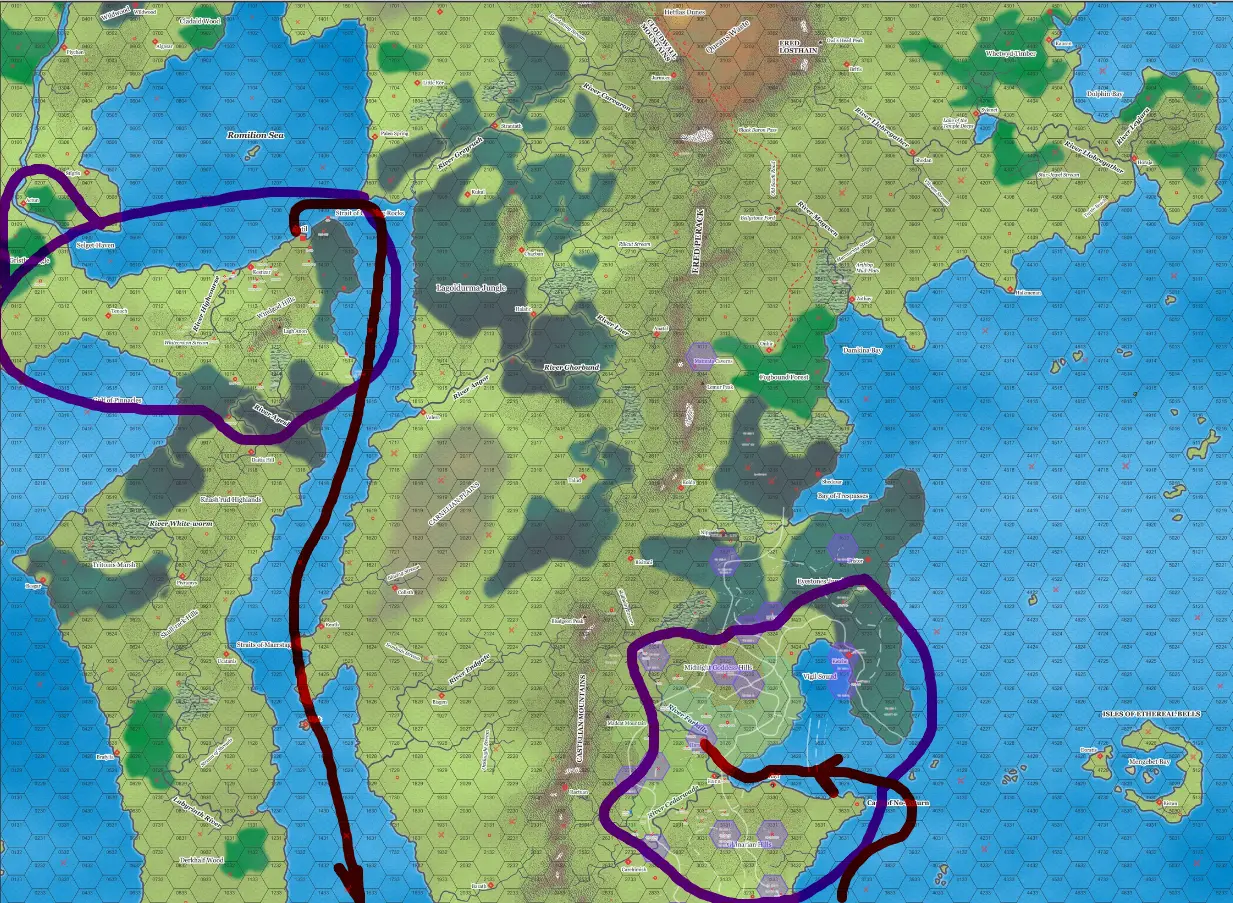
Note: don't study the above screenshot if you are playing in our campaign.
First 50 sessions were around Antil region (center left area). From then on, most of the action has been around the Hara region (centre south area). Adventurers fled Antil on a merchant vessel and disembarked in Hara.
Furthest north they went is up to the Eyestones Jungle; furthest south by the south south of the Ghinarian Hills (where they got smacked and enslaved). They just begun broaching over the hills north-west from their new base in Ironburg.
I wrote high level summary of sessions 50–120 and 120–180, but no maps since they contain a lot of Judge facing information.
Question
Excellent episode guys. Hats off to you Attronarch in particular. Stellar.
Some questions I have: Did a group of mover&shaker PCs establish? If yes, what character levels are they at? In what ways (generally or specifically) have the affected the greater setting?
Answer
Thank you!
With close to 200 sessions a lot has happened, exactly because of player characters interacting with the world. I've been publishing regular session reports, but it would be quite a feat to read them at once. I summarised most important events from sessions 50 to 180 in the following two posts: 50—120, 120—180.
Did a group of mover&shaker PCs establish?
Yes, several times. So far it has mostly resulted with them being shaken out and driven away. There is a lot of political instability in the Barbarian Altanis, civilisation is scarce, and wilderness is well, wild.
If yes, what character levels are they at?
Most recent “mover & shaker” PCs are:
- Gomm, a thief level 6, who established his own hideout in Ahyf, as well as a new, disguised persona of an old sage which he used to convince the Elders to follow his lead. Since Ahyf had been conquered by Wizard-King Racoba his current whereabouts are unknown.
- Dalkanarion, a fighter level 6. He made a name for himself as heroic and just warrior, slew a dragon, and was appointed the Castellan of Cedarwade Keep by the Red Queen. After returning from an expedition (which was Cauldron 2025 session) he was defeated and enslaved by the Bull God tribe. He was rescued with great effort from his fellow adventurers. Unfortunately, he found a Chaotic sentient sword, got dominated when he was weak, killed a fellow adventurer (a hobbit!), seized his ring of invisibility, and fled. His current whereabouts are unknown. (This is being resolved in private play-by-post, in essence 1:1 with player.)
- Ambros, a cleric level 7, was the most influential adventurer. Over several years he became the Patriarch General and Justice Supreme of Kingdom of Hara, and a loyal subject of the Red Queen. On one of the adventurers he had recovered the Golden Gavel of Justice, and became a High Priest of Forseti. This triggered “name level” forces to arrive, in essence his crusading army. Players used to conquer the Cedarwade Keep, pacify some of the area around Midway, and bring Hara back under control. When Dalkanarion was captured, Ambros made the hardest choice in his life. He left Hara, despite intelligence that Racoba is marching with great force, assembled a team of finest adventurers, and went to Ghinarian Hills. Dalkanarion was rescued, but Hara was lost. In the process adventurers lost their vault, reputation, and pride. A bit more:
Kingdom level:
The Indomitable Wizard-King Racoba has subdued eastern Altanis, having crushed the traitorous Red Queen and her incompetent forces. Suffering an embarrassing defeat, her armies fled in all cardinal directions. Racoba is currently exercising his megalomania and dreams of a City-State of his own to eventually challenge the World Emperor himself.
Adventurers grovel and plead at his feet, hiding like mice in a mining thorp at the northern border. The mightiest among them, former Patriarch General and Justice Supreme of Kingdom of Hara, and a loyal subject of the Red Queen, was subjected to painful humiliation ritual. Paladin of Justice carved the Traitor's Mark on his forehead; his life now rendered worthless; and was exiled from the kingdom.
Local level:
As if their humiliation was not sufficient, the newly appointed baron treats them like petulant children. He is trying to recruit the most promising among them and get rid of the rest. He is happy to point them in the direction of trouble he deems unworthy of his men.
But the baron is a former career mercenary and warlord, and is inexperienced with any meaningful governance. It remains to be seen if he delivers what the Wizard-King expects...
In what ways (generally or specifically) have the affected the greater setting?
In so many, and all the ways. At this stage, setting and characters are interwoven. Characters, through their interactions, keep generating encounters, sites, NPCs, etc. Read summary reports above to get an idea.
But perhaps one of the most interesting developments has been the Wizard-King Racoba himself. It is a character that absolutely all the players hate. They never met him. When they arrived to Hara for the first time, they were hired by then current castellan to break up a suspected spy ring. While searching through the undercity they found maps and evidence of foul play, plus Racoba's sigil. At that time Racoba was the Headmaster of Wizard's Guild. He fled, and has been persistent nuisance ever since. Adventurers, over the years, ignored all the bounties on his head, no matter how lucrative. Even when merchant families tried to contract them to hunt the wizard down, they opted not to get involved. But Wizards are megalomaniacs, and this Wizard returned with force, three years later.
And (still assuming) did at any point conflicts of interest between particular PCs arise, as far as influence on the world is concerned?
There have always been disagreement about what to do, which direction to take, whom to align with, but nothing that would split the party. We maintain strict no PVP rule so maybe that contributed. I ask players to discuss and commit together.
Question
Attronarch I read the post im genral above the current major movers before, are these the highest lvs or just the strongest of the current stable? Does the campaign shift geographic focus necessitating changes in stables? Are these the “next gen” of previous PCs?
Answer
Highest level; Ambros is strongest among the clerics, followed by Tam o' Shanter and Tarkus the Promising. Dalkanarion, Balarus, and Beorg the Gravedigger are among the strongest fighters. Ignaeus is the highest level magic-user, but is an elf.
I am not sure I understand the second question. Players choose where their characters go; they are the ones choosing geographic focus. After Hara fell and they lost their army they spent few sessions collecting PCs across the kingdom and getting them to Ironburg.
Nobody created any progeny, yet. Dalkanarion has been most interested in achieving that, got himself a wife and everything, but fate had different plans.
Question
Thanks for the answer and sorry for the confusion. I was confused that after 180 sessions the highest level was 7 so was wondering if it was because multiple people were in multiple parties/tpks/characters getting retired, etc
Answer
I think it is due to a combination of factors, but at its core it boils down to simple numbers stemming from open table. I don't have all the notes with me at the moment, but I would estimate that between 150 and 250 player characters have participated in the campaign so far. All of them took some XP. Most frequent players are also levelling up their whole stable, so XP disperses. Maybe I crunch all the numbers one day! But not today.
Question
I finally listened to the latest episode and it was great and fun to listen.
There was just one thing I’m interested in and it was probably mentioned but I missed it.
Attronarch what System do you run? I tried to find the answer on your website but on there you’ve listed OD&D/S&W, AD&D/OSRIC and B/X.
Do you use all of these? Did you start with one and it evolved into another? Do people use characters from whatever they like and you convert on the fly to match your world?
Like I said it was probably mentioned but I don’t know 😅
Answer
Sessions 1 thru 134 were B/X with Judges Guild house rules; sessions 135 and onwards are Swords & Wizardry Complete Revised with house rules. My plan was to begin with Basic for a year and then choose between OD&D and AD&D. I chose the former. Then I thought I would just take lbbs and a supplements and arrange them a bit so players can reference them easier. Two years later I had nothing except a ton of research notes so I decided to use Swords & Wizardry with house rules and work on the aforementioned for next couple of years.
Question
Cool. Thank you for the reply.
May I also ask why you chose S&W over AD&D? Is it because it’s more flexible due to less rules?
And it’s nice to hear that S&W is capable for this kind of campaign. It’s the only real OSR game that I own (the German translation of S&WC).
Answer
I chose OD&D over AD&D. I fell in love with it via early Wilderlands and Judges Guild material. That's all. Swords & Wizardry Complete Revised is a compromise until I finish what I had initially planned. (As an aside, when you collate all OD&D books and Strategic Review it is over 600 pages. There are a lot of rules in there.)
Question
I have another question.
How do you manage when all PCs at that particular session are in different places on your map and in different activities?
Do you jump back and forth or do you play with one group then the second group and so on till the session ends?
Answer
The first question is for the players to resolve, not myself. If they want to adventure together, and are so far apart, then they have play-by-post between the session to organise that.
It is rare that there are individual characters scattered around like that. They are usually in groups. When that happens, players that show up on any given session decide which group they play.
We play on discord. For each session I create a discord event for which players can sign up for. It is not mandatory, but is useful to signal who will be playing. On the day of the session I ping all the players and ask them what is the plan for tonight. This is more for them than me. Over the years I have been very consistent with my expectations—when we show up to play, you (players) have to have an answer to “what are you doing next.” If they don't, they get a ten minute timer. If they need more time they spend in game time (turns, days, weeks, depending on situation). They come ready.
Question
Awesome podcast, fellas. I really enjoyed it! There's a wealth of great, practical advice and reminders on running a solid game that I think extends beyond just online gaming. Really enjoyed it. Usually I listen to these a few times and this one will definitely be in the rotation, one of my favorites.
Couple questions... with a totally open table:
How do you handle it when a new player joins or an existing player misses, but you are in the middle of something and maybe there's not a seamless “entry path”? Just ignore it – the PC pops in/pops out? Practicality/gamism over “realism” ?
Also, what happens when new player joins or new PC joins (after a death) when everyone else is higher level? Still starts level one, but advances quickly if he can stay alive?
Answer
Thank you, we appreciate your kind words! I tried to focus on practices that worked for us, and which I think can be acted upon.
How do you handle it when a new player joins or an existing player misses, but you are in the middle of something and maybe there's not a seamless “entry path”? Just ignore it – the PC pops in/pops out? Practicality/gamism over “realism” ?
These are two different scenarios, with slightly different emphasis. If a new player is joining our campaign, then the goal is to throw them into action as quickly as possible. If they happen to join a session which resumes a previous expedition, then I decide the exact moment of introduction on a case by case basis.
Are we resuming during a combat round? If I believe it will conclude within 3 rounds, then new player will be rolling for monsters. More than 3 rounds, I work them in. Are we resuming during an underworld expedition? As long as it isn't some hyper-exotic alternative plane of existence or antediluvian place, we will work you in with a simple “What are you doing here?!”
When existing players cannot make a session, and there is a party that is one a expedition, then two things happen. If at least half of the players whose charterers are on the expedition are joining, then it can resume. Character whose players can't make it do not vanish, but are delegated to carrying light sources and similar. Their players designate another player for decision making. Any rolls that might result with their death are mine to roll.
If less than half can show up, that expedition cannot resume. Players have to pick another character they have and figure out what to do with them.
My operating principles could be summed up as shortest time to action, we will work you in, there is no vanishing out of danger. Risk, consequences, and all that.
So far no has attempted to “game” our system.
Also, what happens when new player joins or new PC joins (after a death) when everyone else is higher level? Still starts level one, but advances quickly if he can stay alive?
Every new player get to roll three characters with zero experience. They pick one and introduce them. Then they start playing.
Players can write in-character session reports. Each nets their character 300 XP. After they have written 20 session reports (or created drawings, memes, poems, whatever), all their new characters begin with 5000 XP.
Once a character has been introduced to the game, player can freely choose which one will go on an expedition, engage in downtime, etc. This is helpful for sessions when only two to four players show up. Then each player usually controls two of their characters, plus whatever retinue they have. This enables them to assail bigger dangers. It also backfired several times when they gathered big numbers, stormed a dungeon, and then had to divide experience into twenty shares... Decisions, risk, reward, consequences, and all that...
Yes, exactly. Old player from three months ago drops in, his PC is 300 miles away from the others. He uses a fresh level one PC maybe, that's popped into the main group?
We have that frequently. Some players travel the world for their work and can only play sporadically, or during specific months. I have locations of each character. When they show up, I look up how much in-game time has passed since they played last. Usually enough time to judge they would have been able to travel to where ever action is right now. It hasn't really been an issue so far; we were always able to work out something that has satisfactory verisimilitude.
Question
Hello Attronarch,
I just listened to the CAG podcast's episode on your open-table sandbox campaign! Fascinating!
I am preparing to run an (in-person) open table campaign, so it is really useful to listen to your advice and your players' feedback.
Could you please expand on something that you touched upon towards the end of the episode)? Unfortunately I can't join the campaign to learn by experiencing it (its time conflicts with my work schedule). I would love if you could address it via Discord on or a blog post.
What I am referring to is how you handle continuity/discontinuity between sessions/parties.
The conventional view—or at least the “Alexandrian view”—is that an open table session needs to start in town and end in town—and, if PCs don't, a “table of doom is” used. I haven't tried it, but, I was getting ready to do it... So I was very interested when I hear your take on this, which goes against the conventional view.
Paraphrasing, I think you said the following (I'll be adding some specific questions along the way, and then add some more). For the purposes of this summary, I'll refer to “party XN” as the party (group of players/PC) that exist on a specific session. You said:
(a) Don't force each party to end the session back in town; the session can end in an adventuring location, e.g., deep in the dungeon.
(b) Let's say party A1 ended the last session deep in the dungeon. Next session, if half of the players with PCs in party A1 show up to play the game resumes on the same adventuring location with, e.g., same room of the dungeon; we could call this party A2.
Question 1: how do you handle, narratively, the absence of some PCs of party A1 in the location? (This question assume not every player of party A1 showed up on the next session.)?
Question 2: relatedly, how do you handle, narratively, the presence of PCs of party A2 who were not in party A1?
© A corollary: if less than half of the players of party A1 show up on the next session, then the session focuses on a different location/party (let's call it party B1). I imagine this could be another party that was exploring that location (so its more of a case of party B2).
Question 3 & 4: same questions about verisimilitude mentioned above, related to absence/presence of PCs.
More questions, and perhaps more important questions:
Q5: Did I get it right?
Q6: Could a party C explore the same adventuring location that is being explored by party A?
Q8: More generally, how do you handle the interaction of parties, and their potential impact on the world, when those parties may be operating in different times?
Q9: How do you keep track of who is doing what and when, and interactions between what they do?
Q10: what are other procedures, decision-making processes and resources that you use for this “many parties in many places” approach?
I know it's a lot of questions! Maybe if you explain more your approach many questions will be answered at once! Also, if you have already explained your approach, please point me towards the relevant message/resource where you did—you must be already quite busy running the campaign! Thanks!
And later, an addition.
A related question: how do you allocate XP? When an expedition has ended and the treasure has been taken out? At the end of the session, regardless of where PCs are? And who gets it? PCs whose players are present only?
Answer
Thank you for your kind words. I am happy to hear you found the episode inspiring. I have answered some of the questions above so I will not repeat them at length. Before doing so, I wish to stress that handling “continuity/discontinuity between sessions/parties” is less onerous and disruptive in play than it might seem at first. So, in order.
Q1: I handle this on a case by cases basis. How did the previous session end? How are we beginning the session? Would it be plausible for the player character to leave the dungeon and reach a safe place (a guarded camp, a hidden chamber, a settlement, etc.)? If the answer is no, then the player character does not simply vanish, nor do they “fade to black.” They are still present but delegated to holding light, offering support, and similar. If we ended in a dangerous situation, and the player can't make it, then they nominate another player to take care of their character.
Q2: Likewise, on a case by case basis. I consider the player character, the situation, and the location. Would it be possible for them to simply walk in and join? Is the site expansive enough that they could be just around the corner? We meet weekly for three hours to play, surely we can suspend our disbelief enough to figure out a way to introduce new player character. Over the years we have everything from poof here is a dwarf to divine interventions and simple around the corner they come. All of them worked because they were ground in the current situation.
Q3 & Q4: Same answers as above. Consider the conditions: where are these characters? What are they doing? In practice, treat it as any other expedition, because that is exactly what they are. Thus, answers are the same.
Q5: So far, so good!
Q6: My default answer is no, unless special conditions are met. If it is a sprawling locale (think megadungeon with multiple entrances), then I might allow it. Once an adventuring party enters a locale I am not interested in bringing more different parties at the same time. That is too fragile regarding time coordination. Exceptions are for example if Party A is captured or defeated, and Party C is rushing in to save them. We had that several times during our campaign and it worked fine. For example, when Dalkanarion and others were captured they crawled the deep tunnels, while the rescue party advanced overland, and then crawled other portion of the caves. They eventually reunited, rejoining the parties.
Q7: I don't see question seven, let me know if I accidentally overlooked it.
Q8: Assuming you are asking about play parties, I don't handle their interaction in any particular manner. Those are player characters, they interact with each other as they (i.e. their players) wish. I merely keep track of where and when the characters are. Players do too; I help them if they lose track of time.
Q9: Over the years I have developed a session tracker. I started with pen and paper, then reusable PDF templates (still pen and paper but less prep), and am nowadays using a spreadsheet with those same templates. It consists of four elements:
- Session dashboard. Session number, real-world date, in-game date, for each character: player name, character name, race, class, alignment, armour class, notes (special abilities, memorised spells, etc.), monsters encountered and overcome, treasure recovered, judge's notes.
- Day tracker. Session number, real-world date, in-game date, season, watches, turns, turn notes, day notes, compass. Makes it trivial to mark any unit of time, note anything of significance, and track resources.
- Combat tracker. Session number, real-world date, in-game date,, rounds, round notes, party notes, monsters and monster notes. Goes to 60, i.e. 6 turns or a full hour.
- Calendar. In-game calendar with months, days, and seasons. I mark the first and last day played during the session.
All of these fit a single A4 paper, so I have overview at glance. I might write a longer post on keeping time records in a practical manner. Perhaps later this year. These allow me to quickly get up to speed, calculate experience, check who is who, and who did what, so on and so forth. I use them when writing the session reports too.
Q10: The single most important thing a Judge can do is knowing who is where and when. That is it. When they know that, then they can easily summarise the situation and available options.
Also, I feel it is important to stress that the goal isn't to have “many parties in many places” but that it is something that happens due to open-table and sandbox approach. Thus, the Judge has to be comfortable with it, but should not necessarily strive for it.
As I said on the podcast, a valid reason for that is ending a session while an expedition is ongoing because the party is dealing with a large dungeon, locale, or site. An invalid reason is getting bored, distracted, or whatever, and attempting to start seven parallel expeditions at once. If that is happening, then something is amiss.
I continuously ask players about their plans, goals, intentions, ambitions, and similar. I ask them to discuss them with each other between the sessions, during the sessions, in different ways and scales (e.g. “what are we doing today” versus “what do we want to accomplish over the next three months”). Frankly, I do not care so much about their answers, for they can change their mind at moment's notice. No, the valuable part is them articulating aforementioned to each other, developing alignment, and shared agenda.
After all, they are playing together. Why then would they want to be separated most of the time?
BQ: I allocate treasure and monster experience after the expedition has concluded and adventurers have returned to a safe haven. I go through the session trackers, make a list of all the player characters that have participated, tally up sessions they played in, and then reward shares accordingly. Here is a multi-session expedition example:
SESSIONS 193, 194 & 195 EXPERIENCE
Total experience earned:
5 260 XP.
Eligible characters (number of shares):
- Ainsley (3)
- Ambros (2)
- Aurella (1)
- Balarus (3)
- Hedwig of Hogwarts (1)
- Ivor (3)
- Tam (3)
- Tarkus the Promising (2)
- Thorinda Bung (3)
- Volkard (2)
- Wilbalt (1)
Total number of shares = 24.
XP per share = 219 XP if 5% XP bonus = 230 XP if 10% XP bonus = 241 XP if 15% XP bonus = 252 XP
Reminder that multi-classed characters gain no bonus to earned experience.
No treasure recovered.
The player looks for their character, and then simply multiplies the XP per share with their number of shares. That's it.
More questions?
If you have a question of your own drop it in the comments below or via email. I will answer, but might take some time to do so.
Fight on!
#Resource #Podcast #Reflection
Subscribe to get the latest post in your inbox. No spam.
rootring
Prev · Random · Directory · Next